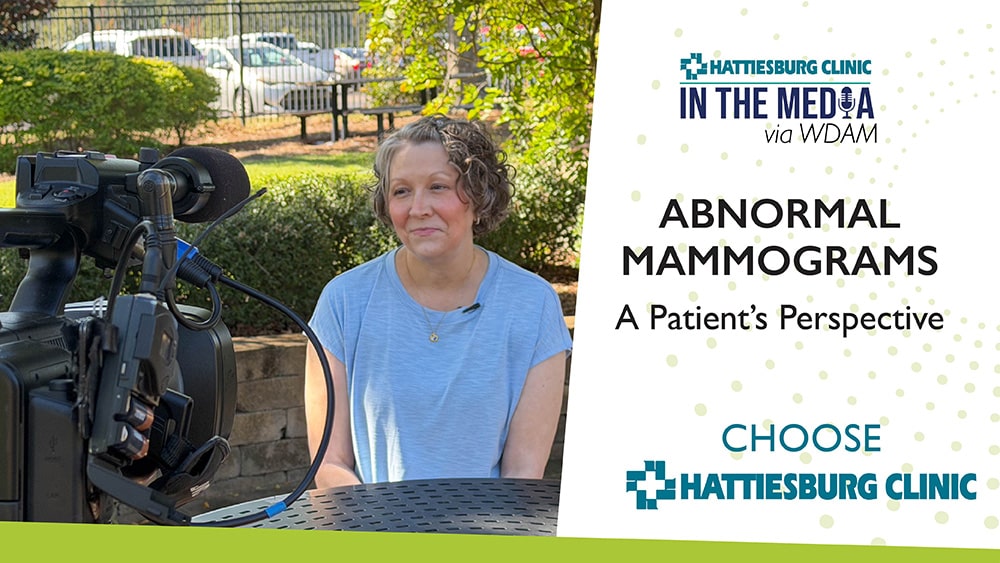
Abnormal Mammograms: A Patient’s Perspective
The American Cancer Society recommends women at average risk for breast cancer should begin yearly mammogram screenings at age 40; about one in every ten of those mammograms comes back as abnormal. While, according to the National Institutes of Health (NIH), fewer than 10% of women who require additional testing following a mammogram are diagnosed with breast cancer, experiencing anxiety after an abnormal mammogram result is normal.
Recently, Martha Cochran, a Radiology Information Systems (RIS) and Picture Archiving and Communication Systems (PACS) Coordinator with Hattiesburg Clinic Imaging, spoke with WDAM about her experience receiving an abnormal mammogram result.
While working in the mammography field for 15 years, Cochran always gave patients the same advice when offering comfort after an abnormal mammogram result.
“I always told patients, ‘It’s nothing until it’s something,’” Cochran said.
But, when she herself received an abnormal mammogram result in September of this year, she had trouble finding comfort in her own words.
“I started panicking and thinking, ‘Okay, now I’ve got to find a surgeon, a plastic surgeon, and what kind of surgery do I want to have, and do I do radiation or chemo?’ And I hadn’t even come back for additional views yet,” Cochran said.
Results from a diagnostic mammogram showed that Cochran was a part of the roughly 90% of women who are not diagnosed with breast cancer after additional testing. There are several, noncancerous causes of abnormal mammograms such as benign calcifications, masses, asymmetries and architectural distortions. For Cochran, the cause was dense breast tissue.
While being called back for additional testing after an abnormal mammogram can cause fear and anxiety, it also means proper care is being provided.
“The doctor did his job, which was to look at my images, compare them to the previous year, and then say ‘Hey there’s a change. We need to get her back,’” Cochran said. If I get called back, that means they’re doing their job. That’s what I tell everybody.”
Yearly mammograms are recommended beginning at age 40, or earlier if certain criteria are met. According to the Susan G. Komen Foundation, most early-stage breast cancers in the United States are discovered through screening mammograms before symptoms appear. Because screening mammograms find cancer in its earliest stages, treatment can begin sooner, and studies show that women ages 50-59 who get yearly mammograms have a 14% lower risk of dying due to breast cancer. For women ages 60-69, yearly mammograms lower the risk of death due to breast cancer by 33%.
View the full interview here.
###
About Hattiesburg Clinic Breast Center:
Hattiesburg Clinic Breast Center is dedicated to providing a private, comfortable setting to meet the special needs of patients for their breast screening and diagnostic exams.
About Hattiesburg Clinic:
Hattiesburg Clinic is Mississippi’s largest privately-owned, multispecialty clinic. Founded in 1963, Hattiesburg Clinic has expanded to include over 450 physicians and providers, along with 2,500 employees, serving patients across more than 17 counties in Mississippi. Hattiesburg Clinic is committed to being the health care provider of choice in the communities we serve.