Understanding Mammograms: Why Abnormal Mammograms Do Not Always Mean Cancer
According to the National Institute of Health (NIH), fewer than 10% of women who require additional testing following a mammogram are diagnosed with breast cancer. However, experiencing anxiety after an abnormal mammogram result is normal, but knowing the many noncancerous causes of abnormal mammograms can help ease feelings of worry and apprehension.
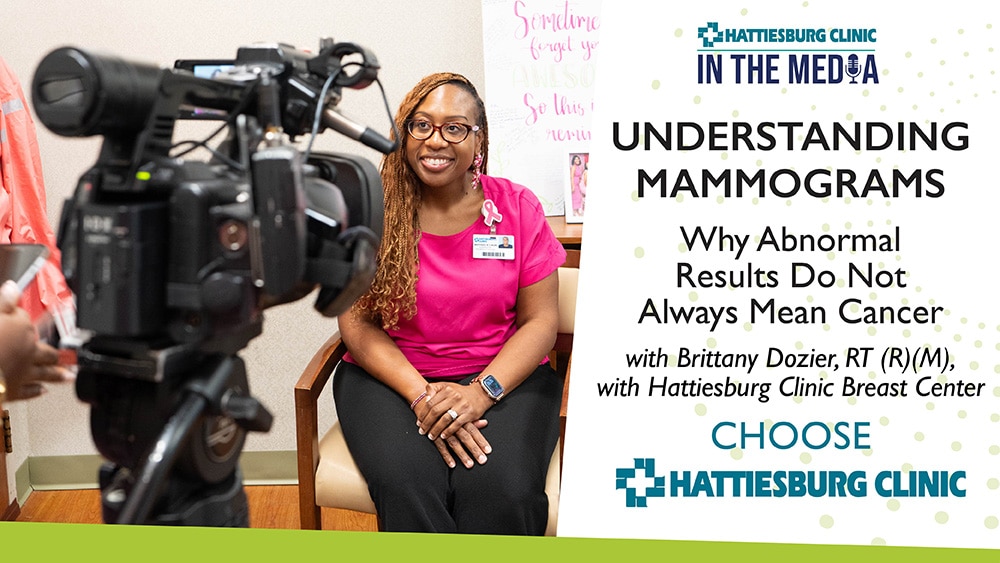
Recently, Brittany Dozier, RT(R)(M), Supervisor at Hattiesburg Clinic Breast Center, spoke with WJTV about the many different, noncancerous causes of abnormal mammograms.
In This Article:
- What is a Mammogram?
- Screening Mammograms VS Diagnostic Mammograms
- What Can Cause an Abnormal Mammogram Result?
- Why Are Mammograms Important?
What is a Mammogram?
Mammography has been around since the early 1900s. Since then, steady advancements have been made, and today, according to the Breast Cancer Research Foundation (BCRF), mammography is the gold standard in breast cancer screening. A mammogram is a combination of X-ray images taken of the breast that are analyzed for any abnormality, such as a mass or microcalcifications, that may indicate the presence of cancer in the breast. Typically, patients receive a standard, 2D mammogram where two images of the breast are taken: one from the side and one from the top. There are two types of mammograms: screening mammograms and diagnostic mammograms.
Screening Mammograms VS Diagnostic Mammograms
A screening mammogram is a routine mammogram, typically once a year, that detects changes in the breast tissue that may indicate the presence of breast cancer. According to the BCRF, since 1989, routine screening mammograms have helped reduce deaths caused by breast cancer by 43%. Most people with breast cancer experience symptoms like a new lump or a mass, but mammograms can detect potential signs of cancer sooner, sometimes up to three years before a mass can be felt. For most women, screening mammograms should begin at age 40.
“A screening mammogram is just like a routine checkup, just like you go to the OB or the dentist,” Dozier said. “We look at the entire breast for any type of abnormality.”
A diagnostic mammogram provides more detailed imagery than a screening mammogram and is used to look at abnormalities in the breast. Typically, a diagnostic mammogram is done if an abnormality is found on a screening mammogram or if a patient is experiencing signs or symptoms of breast cancer such as:
- A new lump or mass in the breast
- Swelling in the breast
- Skin dimpling on the breast
- Redness, flaking or thickened skin on the breast or nipple
- Breast or nipple pain
- Nipple retraction
- Nipple discharge
- Swollen lymph nodes under the arm or near the collar bone
If a screening mammogram is abnormal and a diagnostic mammogram is required, it is natural to feel anxious, but research indicates that it is much more likely for results to be benign than malignant.
What Can Cause an Abnormal Mammogram Result?
An abnormal result from a screening mammogram is not uncommon.
“We get a lot of abnormal mammograms on baseline patients; [an abnormal mammogram] is not uncommon at all,” Dozier said. “Everyone is different—you’re different from me, you’re different from your mom—so we always have to determine what is normal for you.”
During screening mammograms, doctors look for five main changes: calcifications, masses, asymmetries, architectural distortions and breast density.
Calcifications are deposits of calcium in the breast tissue; they show up as white dots on a mammogram. These deposits can be tiny dots, or microcalcifications, or larger macrocalcifications. According to the BCRF, most macrocalcifications occur with age or are a result of inflammation, infection or prior injury to the breast. While microcalcifications can also be benign, they are more likely to be caused by cancer than macrocalcifications. Thirty to 50 percent of breast cancers that cannot be felt are identified by microcalcifications on a mammogram.
“Microcalcification look like little grains of sand or salt,” Dozier said.
Masses refers to any areas of abnormal breast tissue whose shape or edges do not look like the rest of the breast tissue. While masses can be a sign of breast cancer, according to the BCRF, even most solid masses are benign. Masses more commonly end up being fibroadenomas or cysts, both of which are noncancerous.
Breast asymmetry means that one breast or portion of the breast differs from the other breast in either size, form, volume or position. Asymmetries are common and typically benign, according to the BCRF. Causes for breast asymmetry can range from hormonal changes to injury.
Architectural distortions is a term that refers to areas of tissue in the breast that seem pulled or distorted toward a certain point. These distortions can be caused by past injury, procedure performed on the breast or even the way the breast was positioned during a mammogram. Architectural distortions are not necessarily cause for alarm, but when observed on a screening mammogram, they can require additional screening.
Screening mammograms also measure breast density, meaning the amount of glandular and fibrous tissue in the breast compared to the fatty tissue. Breast density is measured on a four-point scale from A to D; A meaning mostly fatty tissue and D meaning extremely dense. According to the BCRF, about half of women, particularly younger women, have dense breasts. Because dense breasts can make it more difficult for abnormalities to be seen on a mammogram, additional screening measures may be beneficial such as a breast ultrasound or magnetic resonance imaging (MRI).
Why Are Mammograms Important?
Yearly mammograms are recommended beginning at age 40, or earlier if certain criteria are met. According to the Susan G. Komen Foundation, most early-stage breast cancers in the United States are discovered through screening mammograms before symptoms appear. Because screening mammograms find cancer in its earliest stages, treatment can begin sooner, and studies show that women ages 50-59 who get yearly mammograms have a 14% lower risk of dying due to breast cancer. For women ages 60-69, yearly mammograms lower the risk of death due to breast cancer by 33%.
Screening mammograms are important, even for women who do not have a family history of breast cancer. According to the Komen Foundation, only about 10 to 15% of women diagnosed with breast cancer have a first degree relative—a mother, sister or daughter—who has also had breast cancer. That means that 85 to 90% of breast cancers are caused by something other than genetics.
“One of the most important things that I want women to know is that your family history plays a part, but not a huge part,” Dozier said. “Breast cancer has to start somewhere, and mammograms can help us find and treat it before it becomes life threatening.”
View the full interview here.
###
About Hattiesburg Clinic Breast Center:
Hattiesburg Clinic Breast Center is dedicated to providing a private, comfortable setting to meet the special needs of patients for their breast screening and diagnostic exams.
About Hattiesburg Clinic:
Hattiesburg Clinic is Mississippi’s largest privately-owned, multispecialty clinic. Founded in 1963, Hattiesburg Clinic has expanded to include over 450 physicians and providers, along with 2,500 employees, serving patients across more than 17 counties in Mississippi. Hattiesburg Clinic is committed to being the health care provider of choice in the communities we serve.