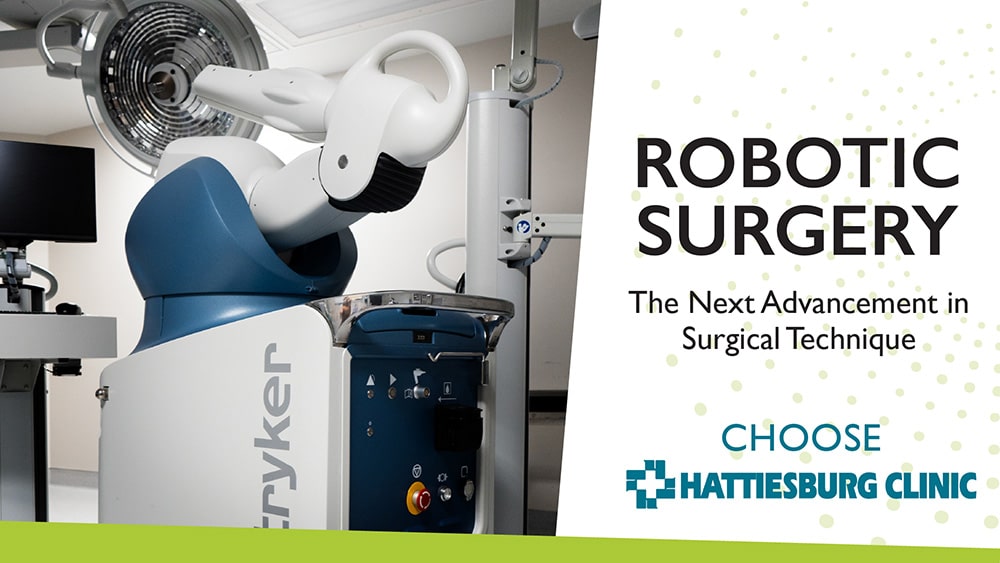
Robotic Surgery: The Next Advancement in Surgical Technique
In the past, surgeries have been performed as “open” or “traditional” procedures, requiring large incisions to allow surgeons access to the body. In the early 1900s, laparoscopic, or minimally invasive, surgery became popular with the invention of the laparoscope, a thin, tube-like instrument with a light and lens used for viewing inside the body through a small incision. Over time, innovations allowed surgeons to operate in less invasive ways, and robotic surgery is one of the latest advancements in surgical techniques.
Christopher N. Painter, DO, anesthesiologist and medical director at Hattiesburg Clinic Lowery A. Woodall Outpatient Surgery Center put it simply: “Robotic surgery is the latest advancement in medicine from a surgical standpoint. It is the next advancement in surgical technique.”
How Robotic Surgery Works
Robotic surgery is not performed by a robot. Rather, it is performed by a surgeon who utilizes a robotic device that can hold small surgical instruments. The surgeon moves the arms of the robot using controllers and a viewing screen.
The technology used in robotic surgery consists of three main parts: robotic arms, a high-definition camera and a surgical console. The robotic arms hold tiny instruments while the high-definition camera provides enhanced, magnified, 3D views of the surgical field. The surgical console is where the surgeon controls the instruments and the camera’s movement with controls guided by the surgeon’s hands.
“You have a robot that is basically an octopus with a lot of arms,” Painter said. “The surgeon has hand pieces that they manipulate and move, and that translates into the robotic arms going in and out of the patient, cutting and tying things.” Painter went on to explain that whatever the surgeon does at the console is transmitted to the robot which precisely mimics the action.
During robotic surgery, the surgeon will start by making one or more small incisions and place thin tubes, called ports, through these incisions. The surgeon will then attach robotic devices to the ports, which serve as a sort of tunnel, and place instruments through them. Next, a long, thin camera called an endoscope is placed through one of the ports. This camera provides the high-definition, 3D images the surgeon sees throughout the procedure. To perform robotic surgery, surgeons are required to complete additional, specialized training.
Benefits of Robotic Surgery
Compared to open or traditional surgery, robotic surgery requires a much smaller incision which leads to a lower risk of infection, reduced blood loss, smaller scars and less pain during recovery. Overall, these benefits require a shorter stay in the hospital or outpatient surgery center post-op.
Robotic systems can increase precision, flexibility and control during procedures. Additionally, robotic arms have a greater range of motion than a human hand, allowing surgeons to rotate instruments in tight spaces, making them more adaptable in the surgical field.
Traditional surgery requires a lot of moving parts in the surgical field like hands and instruments. Robotic surgery eliminates the need for a lot of those things. “It allows the surgeon to focus on what he or she needs to, and the robot does all the delicate, intricate work,” Painter said.
Choose Hattiesburg Clinic
Robotic surgery is an option for many procedures, including hernia surgery, colorectal surgery and anti-reflux surgery. If a physician or provider recommends surgery as a treatment option for a medical condition you have, the surgical team at Hattiesburg Clinic is here to offer advanced surgical options. Our team of board-certified surgeons uses the latest advancements in technique and technology to provide patients with safe, effective and optimal surgical care. Whenever possible, we offer patients access to minimally invasive procedures, including traditional surgery and robotic surgery.
###
About Hattiesburg Clinic Lowery A. Woodall Outpatient Surgery Center:
Lowery A. Woodall (LAW) Outpatient Surgery Center has been providing outpatient services to South Mississippi residents since 1984.
The care we provide to our patients is a top priority. All LAW registered nurse staff members are certified in Advanced Cardiac Life Support (ACLS) and Pediatric Advanced Life Support (PALS), to perform life-saving actions if complications arise. All staff is Basic Life Support (BLS) certified. We proactively attempt to contact our patients by phone within 24 business hours post discharge to assist them in communicating any necessary needs to their physician. We implement best practices by following national guidelines for hand hygiene and infection prevention. LAW provides reports yearly to the Centers for Disease Control & Prevention’s National Healthcare Safety network to ensure we are maintaining quality standards of care.
Our mission is to provide high-quality, patient-centered health care in an efficient and cost-effective manner. Our goal is to be the health care provider of choice in the communities we serve.
About Hattiesburg Clinic Surgery:
Hattiesburg Clinic Surgery covers all aspects of patient care related to surgery. Our providers offer surgical diagnostic and treatment expertise in the management of disease of the digestive tract, breast, endocrine system, surgical oncology (i.e., breast cancer, colorectal cancer, stomach cancer), thyroid cancer and vascular access.
About Hattiesburg Clinic:
Hattiesburg Clinic is Mississippi’s largest privately-owned, multispecialty clinic. Founded in 1963, Hattiesburg Clinic has expanded to include over 450 physicians and providers, along with 2,500 employees, serving patients across more than 17 counties in Mississippi. Hattiesburg Clinic is committed to being the health care provider of choice in the communities we serve.