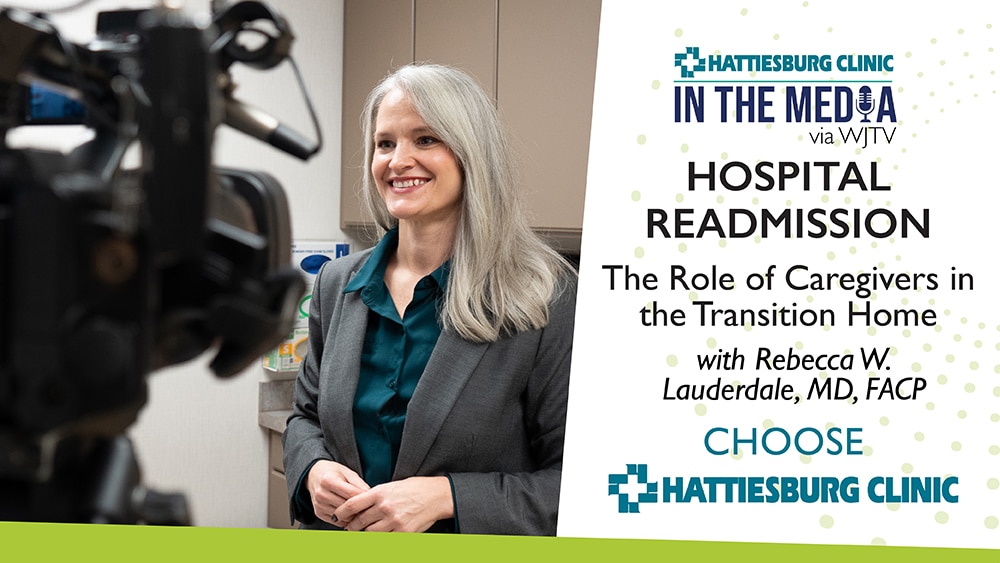
Hospital Readmission: Supporting Caregivers in the Transition Home
Recently, Rebecca W. Lauderdale, MD, FACP, with Hattiesburg Clinic Comprehensive Care, spoke with WJTV regarding the important role of caregivers in reducing hospital readmission rates. Hospital readmission refers to a patient having to be readmitted to the hospital within 30 days of being discharged. Readmissions are associated with increased illness, death and health care costs. While some hospital readmissions are unavoidable, there are several ways to prevent readmissions. One of the most crucial ways is with a caregiver.
In this article:
- Why the First Few Days Matter
- Being Involved Before Leaving the Hospital
- Medication Assistance
- Keeping Follow-Up Care on Track
- At-Home Monitoring
- Advocating for the Patient
Why the First Few Days Matter
According to the Agency for Healthcare Research and Quality, approximately 14 percent of patients are readmitted to the hospital within 30 days, and more than one-third of those readmissions happen within the first seven days. When a patient is discharged from the hospital, they are given a personalized care plan, sometimes referred to as discharge instructions, designed to ensure they continue to heal outside of the hospital. While this plan may look different for everyone, a critical component of a successful transition home is a caregiver who can step in to assist the patient as they recover. One of the most vulnerable times in a patient’s recovery is the transition from the hospital back into the home.
“The first few days, especially after a hospital discharge, is kind of a vulnerable time for a patient,” Dr. Lauderdale said. Because of this, it is important that caregivers understand the crucial role they play in the healing and overall health of patients.
Being Involved Before Leaving the Hospital
One of the most important things a caregiver can do is ensure they understand the patient’s discharge plan. Before leaving the hospital, a caregiver should know:
- What medications need to be taken and when
- Which doctor or specialist the patient needs to see and when
- Any special instructions for wound care, mobility assistance or dietary restrictions
- What symptoms may require immediate medical attention
Information about a loved one’s discharge from the hospital can seem overwhelming; make sure to ask clarifying questions, obtain relevant contact information for the patient’s care team and ensure written instructions are available. Most facilities will provide a discharge summary detailing the reason for the patient’s hospital stay, care that was administered during the hospital stay, discharge instructions, medications needed and even follow-up appointments that have been scheduled or need to be scheduled. This summary is a good place to include any additional information provided by the patient’s care team.
“Having that second set of eyes and ears is really helpful,” Lauderdale said. “They [caregivers] can make notes on their discharge papers as someone is going over the information with them in the hospital. That’s a great thing to do so that you are really clear about what’s happening.”
Medication Assistance
According to the National Institutes of Health (NIH), medication-related issues are one of the top reasons for hospital readmissions. Medication-related issues refer to a variety of incidents including:
- Newly prescribed medications or altered dosages during or after hospital discharge that cause adverse reactions
- Medication mismanagement, including misunderstanding or forgetting medication instructions, leading to incorrect dosages
- Lack of access to medication, including cost or ability to retrieve it from the pharmacy
Caregivers can provide medication assistance by ensuring prescriptions are obtained, any changes in medication or dosage are understood and any problems are addressed.
Keeping Follow-Up Care on Track
The Journal of the American Medical Association (JAMA) states that adequate outpatient follow-up within 30 days of hospital discharge significantly reduces the risk of 30-day hospital readmission for all causes. This reduction can have a substantial impact on the overall quality of care patients receive. As a caregiver, keeping follow-up care on track can mean helping to schedule appointments, providing or arranging transportation or helping patients remember appointments and medications. Lauderdale recommends her patients be seen by their primary care physician within three to seven days of discharge from the hospital.
“We’re really trying to get them in within those first few days because that’s when the big mistakes or misunderstandings happen or things fall through the cracks,” Lauderdale said.
Research conducted by the NIH suggests when patients feel supported, informed and connected to their care through a primary care physician after they are discharged from the hospital, they are more likely to recover at home and avoid being readmitted to the hospital. Additionally, when hospital care providers are confident in a patient’s primary care team and their support system—when they know the test results will be reviewed, referrals to specialists will be made, the patient has access to care outside of the hospital—they are more likely to feel comfortable discharging a patient sooner.
At-Home Monitoring
During a hospital stay, patients spend an inordinate amount of time in bed. This can lead to muscle atrophy, joint stiffness, blood clots, pressure injuries and overall functional decline the patient may not notice right away.
“When a patient has been sick in the hospital, they leave and go home [and] don’t really quite understand until they get home what their physical limitations may be,” Lauderdale said.
As patients transition home, it is important for caregivers to pay attention to how they function in day-to-day activities and make note of any difficulties they may have. If an activity or movement seems particularly difficult, the caregiver should reach out to the patient’s care team to relay these observations and coordinate appropriate care. Fall injuries are a common cause of hospital readmission.
Advocating for the Patient
One of the most important jobs of a caregiver is to be an advocate for the patient both during their hospital stay and after, as they recover. Medical staff and care teams want patients to heal successfully and have a vested interest in avoiding hospital readmission. There are multiple ways to be an advocate, but they all begin with staying in contact with the patient’s care team. When questions arise, confusion sets in or extra care or coordination is needed, the care team acts as a safety net to ensure both the patient and caregiver have the proper information, tools and capacity for successful recovery.
“We’ve got kind of a failsafe there, a redundancy in our system, to make sure that there’s always somebody they can get ahold of and get those answers,” Lauderdale said.
View the full interview here.
###
About Hattiesburg Clinic Comprehensive Care:
Hattiesburg Clinic Comprehensive Care is a primary care medical practice tailored specifically to care for patients who live with complex medical conditions. We have a team of physicians, nurses, and nurse caseworkers that are experienced in and dedicated to the care of patients with conditions such as diabetes, heart failure, hypertension, chronic pulmonary disease, and others. Our goal is to serve as a medical home for patients with multiple medical needs and to manage their care in such a way that their quality of life is improved and the day-to-day workload of managing their illnesses is reduced.
We manage medications, testing, and coordination with specialists and community resources such as home health agencies. Our patients are referred by primary care providers or specialists and sometimes have no primary care provider, despite their high-risk conditions. Our on-site services include, but are not limited to, IV and IM administered medications, respiratory treatments, EKGs and case management.
About Hattiesburg Clinic:
Hattiesburg Clinic is Mississippi’s largest privately-owned, multispecialty clinic. Founded in 1963, Hattiesburg Clinic has expanded to include over 450 physicians and providers, along with 2,500 employees, serving patients across more than 17 counties in Mississippi. Hattiesburg Clinic is committed to being the health care provider of choice in the communities we serve.
