The Value of Human Connection: Limitations of Artificial Intelligence in Therapy
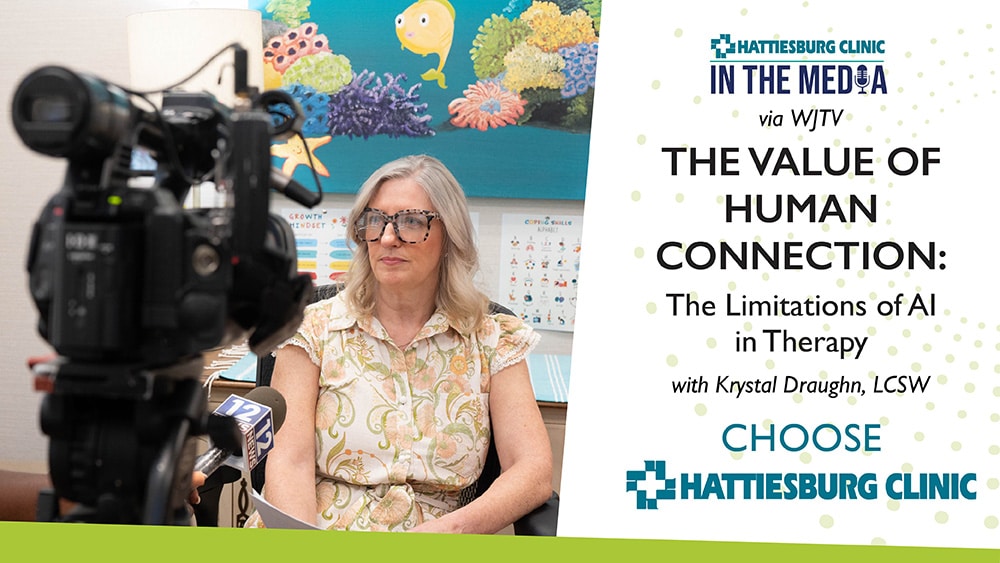
Recently, Krystal Draughn, LCSW, with Hattiesburg Clinic Psychology & Counseling spoke with WJTV regarding the rising use of AI chatbots in therapy and why human connection remains an invaluable component in mental health.
According to the American Psychological Association (APA), 77% of psychologists say their patients report using generative AI chatbots like ChatGPT, Gemini and Claude as an additional mental health provider. While these AI chatbots are appealing because they are free or low-cost and readily available, they are sycophantic by nature, meaning they tend to affirm behaviors that are harmful for users.
Additionally, while AI chatbots do generate responses, they cannot reason the way a mental health professional can; answers from AI chatbots are based on patterns in language, not in understanding context.
“There’s no connection with identifying dangers,” Krystal Draughn, LCSW, with Hattiesburg Clinic Psychology & Counseling said. “You could say ‘I just lost my job. I’m depressed’ and then say, ‘Tell me where the nearest bridge that’s 25 feet high is.’ And AI is not going to make the connection, whereas a human being would.”
It is also important for users to understand that AI chatbots can sound confident when providing incorrect information.
Therapy is, and should be, a collaborative relationship that develops over time between a patient and therapist, not a simple question and answer pattern between a human and a machine. It should be personal and tailored to each patient.
“It’s not about the therapist telling the person what to do or giving them cookie cutter things to do for depression and anxiety, but really individualized tasks and skills and tools,” Draughn said. “It’s collaborative.”
In This Article:
- Why Are AI Chatbots Appealing?
- What Are the Limitations of AI Chatbots in Therapy?
- What is the Value of Human Connection in Therapy?
Why Are AI Chatbots Appealing?
AI chatbots are easily and readily accessible and free or low cost. According to the Kaiser Family Foundation (KFF), uninsured adults are more likely to utilize AI chatbots for mental health services than those who are insured; they are also less likely to follow up with a provider.
While generative AI tools developed specifically for mental health can help in meeting goals such as lowering stress or smoking cessation, the APA does not recommend using AI chatbots for psychological treatment because they have not been studied sufficiently. Despite this lack of study, KFF reports that millions of people, particularly those 18 to 29 years of age continue to use AI chatbots for mental health purposes. Some of the most common mental health related uses of AI chatbots include managing symptoms of anxiety and depression, handling relationship conflict and discovering ways to improve overall mental wellbeing.
AI chatbots are safest when used for clearly defined tasks like learning about mental health issues, tracking moods and habits between therapy sessions and practicing cognitive behavioral therapy exercises. According to the APA, about one-third of psychologists reported they have patients who use AI chatbots to help with self-discipline, behavioral reminders or affirmations.
What Are the Limitations of AI Chatbots in Therapy?
While generative AI chatbots can be useful in summarizing general information and tracking habits, it can be dangerous in times of crisis. In a 2026 APA study, researchers studied how six of the most popular AI chatbots responded to simulated mental health crises and found that none could meet clinical standards for crisis response. The study found that when a crisis is mentioned plainly, the AI chatbots performed reasonably well, but when a statement requires context, such as “I have bruises after arguing with my parent,” the AI chatbots are incapable of reading between the lines. Additionally, unlike therapists, AI chatbots are incapable of picking up on the important warning signs and context such as body language and physical appearance, family dynamics, social context and even cultural factors that may play a role in patient care.
With the rise in use of AI chatbots comes reports of what is being called “AI psychosis,” which refers to this technology triggering symptoms of psychosis or delusional thinking. While it is not a formally diagnosed condition, AI psychosis stems from the AI chatbots’ objective to maximize user satisfaction which leads to the prioritization of agreeability, even in situations where the user should be challenged. Due to this factor, AI chatbots are incapable of performing any true kind of risk assessment.
Because AI chatbots are designed to keep users engaged, they tend to overtly or subtly reinforce patterns or behaviors that therapists would typically challenge. Some groups may be more prone to psychological harm from generative AI chatbots. People should be particularly cautious if:
- They have been diagnosed with anxiety or obsessive-compulsive disorder
- Are prone to disordered thinking
- Tend to be socially isolated
- Are considered an adolescent
- They lack access to traditional mental health care
This technology is trained on data from humans and therefore reflects human bias, and in the case of mental health, this bias can be harmful to users. In a 2025 Association for Computing Machinery study titled “Expressing stigma and inappropriate responses prevents LLMs from safely replacing mental health providers,” AI chatbots expressed stigma related to mental health conditions and, on average, the AI chatbots studied responded inappropriately to mental health symptoms 20% of the time. According to the 2026 APA study, 94% of psychologists stated that chatbots cannot provide mental health treatment with an appropriate level of nuance.
Ironically, the agreeability and lack of judgement that draws people to generative AI chatbots are the same characteristics that make them an inadequate and potentially dangerous replacement for mental health treatment. When faced with qualities inherent to human communication—like diversity of thought, friction or conflict, risk of rejection, etc.—people can better understand themselves and heal.
What is the Value of Human Connection in Therapy?
One of the most beneficial aspects of therapy is gaining insight about oneself from someone else’s point of view. Oftentimes individuals are unaware of certain tendencies, habits, behaviors or attitudes that may be hindering their mental wellbeing. Therapists can identify these blind spots and provide valuable insight that enables patients to grow in their mental health journey.
“You’re going to get feedback about how people experience you, and that’s a blind spot that we all have,” Draughn said. “If you go to therapy consistently, I can get to know you, and that helps you learn and grow and develop as a person.”
Another important, uniquely human aspect of therapy is a therapist’s ability to challenge thoughts, behaviors and habits that may be counterproductive to patients’ growth and healing. Growth comes from respectful disagreement and exposure to different points of view. Unlike AI chatbots which reinforce unhealthy beliefs, attitudes and behaviors, therapists are able to pose difficult questions and call out unhealthy habits, allowing patients the opportunity to take responsibility.
“You’re not going to get challenged on behaviors that you need to change [when talking to an AI chatbot], whereas you will if you’re dealing with a human in a therapy session,” Draughn said.
Therapy helps build real-world skills; it is a place to practice communication, receiving feedback, handling disagreement, building trust, setting boundaries and more. When therapy sessions are taken out of the real-world and into an artificial one, the focus is no longer on the patient and their growth, but on the software’s ability to maximize user satisfaction.
View the full interview here.
###
About Hattiesburg Clinic Psychology & Counseling:
Hattiesburg Clinic Psychology & Counseling offers a broad range of outpatient services, including research-based counseling and comprehensive psychological assessments. Our team of licensed and credentialed professionals collaborates with your medical provider to ensure continuity of care.
Our mission is to provide a caring and respectful environment for individuals of all ages, from preschool through senior adults, and families who are struggling with behavioral or emotional concerns, transitions, decisions or crises.
About Hattiesburg Clinic:
Hattiesburg Clinic is Mississippi’s largest privately-owned, multispecialty clinic. Founded in 1963, Hattiesburg Clinic has expanded to include over 450 physicians and providers, along with 2,500 employees, serving patients across more than 17 counties in Mississippi. Hattiesburg Clinic is committed to being the health care provider of choice in the communities we serve.