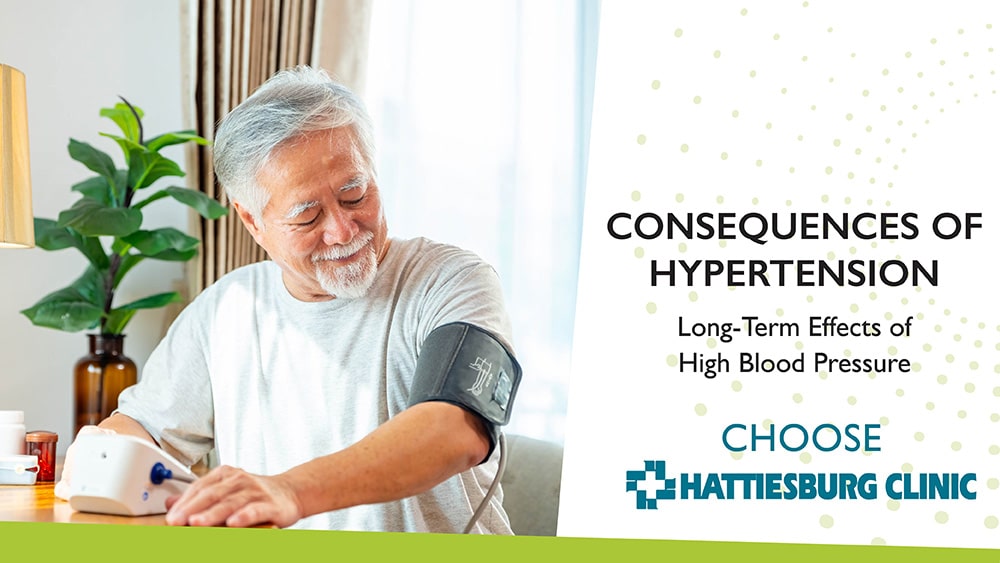
Long-Term Effects of Untreated High Blood Pressure
Hypertension, commonly referred to as high blood pressure, is a common condition in which the force of the blood pushing against the artery walls is consistently too high.
“In your body you have arteries, and they take your blood from your heart to the rest of your body, and that’s the way the body carries oxygen,” Anna Beth Case, MD, with Hattiesburg Clinic Collins Family Practice Clinic explained. “So when you go to a clinic, they usually give you two numbers. The top number, which we like to be less than 120, is the pressure in those arteries when your heart squeezes. And then the bottom number, which we like less than 80, is the pressure in those arteries when your heart relaxes.”
The American College of Cardiology and the American Heart Association separate blood pressure into four general categories:
- Normal blood pressure: Blood pressure that is lower than 120/80
- Elevated blood pressure: The top number ranges from 120-129 and the bottom number is below 80
- Stage 1 hypertension: The top number ranges from 130-139 or the bottom number is between 80-89
- Stage 2 hypertension: The top number is 140 or higher or the bottom number is 90 or higher
Blood pressure higher than 180/120 is considered a hypertensive emergency.
- What Factors Contribute to High Blood Pressure?
- Are There Symptoms of High Blood Pressure?
- What are the Risks of Long-Term, Untreated Hypertension?
- Why Choose Hattiesburg Clinic for Hypertension Care?
What Factors Contribute to High Blood Pressure?
Many factors can contribute to high blood pressure. While things like genetics, family history and age cannot be helped, other factors such as diet, physical activity, alcohol consumption and tobacco use can be controlled.
“It runs in families, and you can do all the right things and still get it,” Dr. Case said. “And sometimes, you can be being really stressed, not getting enough sleep, all those are important too.”
While genetics does contribute to high blood pressure, it is likely people with a family history of hypertension share common environments and other factors that can increase risk. The risk for hypertension increases even more when family history is combined with unhealthy behaviors like poor diet and exercise. A diet too high in sodium and too low in potassium puts you at risk for high blood pressure. Case explained table salt is not the only source of high levels of sodium in food.
“When I say limit salt in your diet, people think putting salt on their food, but it’s actually already in the food, just as a preservative,” Case said.
Regular exercise strengthens the heart and blood vessels, which contribute to healthy blood pressure. Additionally, physical activity can help maintain a healthy weight, which also lowers the risk of hypertension. Additionally, overconsumption of alcohol and the use of tobacco increase risk of high blood pressure.
Are There Symptoms of High Blood Pressure?
Typically, hypertension is asymptomatic, even if blood pressure reaches dangerously high levels. However, some people have reported headaches, shortness of breath and nosebleeds, but these symptoms are not specific and typically do not appear until blood pressure has reached severe or life-threatening levels (around 180/120). Due to its asymptomatic nature, it is important to check blood pressure regularly.
“That’s the problem with blood pressure, it’s the ‘silent disease,’” Case said. “It’s up and you’re used to it being up—you don’t even notice it for a long time, and at that point, a lot of time has passed and it’s already done some damage.”
What are the Risks of Long-Term, Untreated Hypertension?
High blood pressure threatens not only your health, but your quality of life. Over time, untreated hypertension can have severe, adverse effects. “If the heart is having to pump against a high pressure, that’s a lot of stress over time which can lead to heart attacks,” Case said. “If blood pressure is consistently too high, it puts stress on the blood vessels and can increase the risk of stroke.”
Heart attack and stroke are just a couple of the potential consequences of uncontrolled hypertension. According to the American Heart Association, sustained high blood pressure can also lead to heart failure, kidney disease or failure, vision loss, heart disease, plaque buildup in the arteries and even sexual dysfunction.
Why Choose Hattiesburg Clinic for Hypertension Care?
At Hattiesburg Clinic, we provide comprehensive, patient-centered hypertension care. Our experienced physicians and providers offer personalized treatment plans and work closely with each patient to manage blood pressure effectively. With a focus on both prevention and management, we use evidence-based strategies and tools to help patients achieve their health goals.
###
About Hattiesburg Clinic Collins Family Practice Clinic:
Hattiesburg Clinic Collins Family Practice Clinic provides comprehensive evaluation and care to meet the total health needs of each family member. These physicians offer prompt, complete assessment of the patient in their home communities and are able to obtain and coordinate consultation with other specialists when necessary. Family physicians receive training in six broad areas of medicine: pediatrics, internal medicine, obstetrics and gynecology, psychiatry, surgery and community medicine. Their diverse training allows them to offer continuing, comprehensive care from the newborn to the grandparent.
About Hattiesburg Clinic:
Hattiesburg Clinic is Mississippi’s largest privately-owned, multispecialty clinic. Founded in 1963, Hattiesburg Clinic has expanded to include over 450 physicians and providers, along with 2,500 employees, serving patients across more than 17 counties in Mississippi. Hattiesburg Clinic is committed to being the health care provider of choice in the communities we serve.